

Collateral Damage—Sarah Hauser

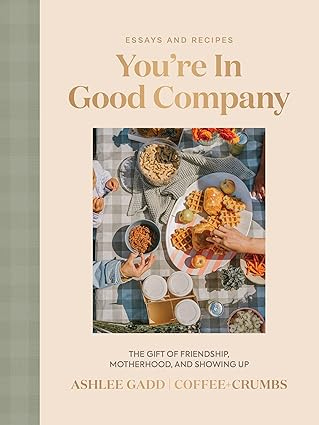
This essay is an excerpt from the book You’re in Good Company, a heartfelt collection of stories celebrating the unique roles that friendship, food, and hospitality play within the context of motherhood. Through captivating and honest essays, You're in Good Company invites you to rediscover what hospitality can look like in a rushed and increasingly isolated world. Find out more about the book here.

I’m standing in the guest room at a family friend’s house, rifling through my suitcase to find the shirt my toddler needs. My laptop sits open on the bed, and my son is lying on his stomach in front of it, hands propped under his chin, giggling at Bluey and Bingo and the silly antics of cartoon dogs playing on the screen.
A few months ago, my husband and I decided to relocate. Instead of house-hunting with our entire motley crew, which would have required my oldest three to miss school and my husband to take off work, my two-year-old and I left the rest of them in Illinois and flew to North Carolina on our own in search of a new home. My son and I are staying with longtime family friends who just so happen to live in the next town over from where we’re looking to move. This couple has known me since I was in seventh grade and feel almost like an aunt and uncle. We’ve stayed connected over the course of decades, and they’ve kindly offered their place as a home base for us during the moving process.
This will be easy, I had thought a couple days earlier as I packed our bags. I’ll only have one kid with me instead of all four. But that one kid loves to climb and run and make messes. And so today, standing in the guest room, with my back momentarily turned as I dig through our luggage, that child shimmies off the bed, feet first, to get down. Except he’s too far towards the top of the bed and slides down at an angle where his feet meet the lamp sitting on the nightstand. It hits the floor with a crash, the lamp shattering into hundreds of pieces.
The sound of the breaking glass startles me, and I turn around to see the cause. “Sam! No!” Oh shoot, oh shoot, oh shoot. My heart races and my eyes dart back and forth, taking inventory of the amber colored pieces all over the floor.
Did I mention this home is beautiful––stunning, actually––and many of the items in the home are one-of-a-kind antiques, carefully collected and curated over decades?
In other words, did my son just break an irreplaceable treasure?
There is no fixing it, just cleaning to do. I move my son to the other side of the room where he won’t risk getting cut by the shards and then find a broom and vacuum in the downstairs closet. My heart continues to race. The tears start to fall. A knot forms in my stomach. As I sweep, I rehearse in my mind what to say when our family friends arrive back home. I text my husband about what happened so he can mentally prepare for the replacement lamp we’ll need to purchase.
The minute our hosts walk in the door, I meet them in the entryway and burst into tears. “I’m so sorry!” The words gush out of me like a firehose as I explain what happened. “I know that was probably an antique and we will buy you a new lamp and I’m so sorry!”
They look at me kindly, their eyes wide with surprise––not because of the incident, but because of my response. They shake their heads with a smile, and one of them speaks up. “Sarah. It’s just a lamp.”
About a decade ago, before we had kids, my husband and I hosted extended family for Thanksgiving dinner. I planned the menu weeks in advance, and, like the organized hostess I wanted to be, tracked what everyone was bringing on an Excel spreadsheet. The night before, my husband and I moved the couch out of our living room so we could put two tables together, end to end, to fit everyone. I covered the tables with a giant tablecloth, set out the platters and serving ware we’d need the next day (with labels indicating which piece would be used for which dish), and made sure we had room for every person and every item. The dining room, which was far too small to hold a sit-down meal with the whole family, would be used for appetizers and drinks.
In that dining room, we had a black bar cabinet with doors that swung open a full 180 degrees. You could then pull out an extension piece to sit on top of the opened doors to create a long, buffet style table to use for serving. We set out bottles of wine, glasses, and a few hors d’oeuvres across the top so people could pour a drink and enjoy a few bites before the main course. Perfect, I thought, as I gingerly pushed the base of a wine glass just so, making sure it lined up perfectly with the rest of the row. I let out a deep breath. We’re ready.
One by one, families arrived, and before long the noise of kids and clinking dishes and conversation filled the house. I returned to the kitchen, and as I stirred more butter into the mashed potatoes and poked the turkey with a meat thermometer, I heard a crash. I looked over at our dining room––the room with the white carpet––and saw my elementary-aged niece standing next to the cabinet, red wine and broken glass splayed across the floor in front of her. She had tried to close the cabinet doors without realizing they were holding up the table extension––and therefore the drinks sitting on top of it. When she innocently shifted the door, thinking she was merely closing an opened cabinet, everything above it––an open bottle and wine glasses––came crashing down, the formerly white carpet now looking like a burgundy-colored Jackson Pollock painting.
I was deeply annoyed.
We’d only lived in that house a little over a year, and I had hoped the carpets would have stayed white a bit longer. And even though the wine glasses weren’t expensive, we only had so many. Not to mention, an entire bottle of wine was now gone, and Lord knows you can’t run out of wine at a party.
My own kitchen preparations came to a screeching halt as the cleanup process ensued. My brother-in-law moved his daughter out of the way and started picking up the largest pieces of glass. My husband grabbed the vacuum cleaner, and my sister found the OxiClean under my kitchen sink. I grabbed rags from the cabinet to help, gritting my teeth in frustration and not hiding my annoyance all that well.
There goes my carpet, I thought. I didn’t say that, thankfully, but graciousness sure wasn’t my default response. Still, I managed to (mostly) hold my tongue. My sister apologized about a thousand times, and while the OxiClean soaked into the carpet, we moved on to enjoy our turkey and stuffing––a wine glass, a bottle of red, and my own attitude the only things worse for the wear.
There’s a scene in the beginning of The Hobbit where a group of dwarves overrun the home of the protagonist hobbit, Bilbo Baggins. Bilbo had sort of reluctantly––and mistakenly––invited the wizard, Gandalf, to tea one day. But when he answered the door, an uninvited dwarf stood there.
Bilbo didn’t quite know what to do. He let the dwarf in, and the dwarf quite quickly made himself at home. Then there was another, even louder, ring at the door. Another dwarf stepped in, uninvited but acting like he was meant to be there all along. The second dwarf asked for beer and cake, and then to Bilbo’s surprise more dwarves rang the bell and entered. Then more, and more, until thirteen dwarves and the wizard ended up descending on his house asking for coffee and red wine and pork-pie and salad and cakes and eggs. “By the time [Bilbo] had got all the bottles and dishes and knives and forks and glasses and plates and spoons and things piled up on big trays, he was getting very hot, and red in the face, and annoyed.”1
In our neighborhood, there’s a group of kids who run around from house to house, playing kickball and raiding pantries and eating whatever they can find at whatever home they land at around mealtime. It’s what I dreamed of for my kids. But when it’s my pantry and my food and my floors that get messier, my temptation is to feel more like Bilbo––red in the face and annoyed. I’m happy to show hospitality when I can plan ahead and the house isn’t destroyed and I still have food left in the pantry. I want the kind of hospitality I have control over. But controlled hospitality can be a selfish version of the welcome we’re meant to show.
Ten years, four kids, and a rescue dog since that Thanksgiving incident, I’ve learned a thing or two about spills. I’ve learned which carpet cleaners are best and that purchasing the carpet shampooer is 100 percent worth it. I’ve learned school-aged kids can put Tolkien’s dwarves to shame in an eating contest, the pile of shoes by the front door is a beautiful sight, and it’s important to keep allergy-friendly snacks on hand so no kid feels left out.
I’ve also learned, as Tim Chester once wrote, that “[h]ospitality will lead to ‘collateral damage.’”
“Food will be spilled on your carpet,” Chester continued. “You’ll be left with clearing up. Your pantry may be decimated. But remember that God is welcoming you into his home through the blood of his own Son. The hospitality of God embodied in the table fellowship of Jesus is a celebration and sign of his grace and generosity. And we’re to imitate that generosity.”2
I wish I had read those words before my niece spilled red wine in my dining room. Maybe I would have handled that situation better. I should have looked her in the eyes and said without hesitation, “It’s just a carpet.” Because hospitality doesn’t always look like relaxing dinner parties or serene coffee dates. More often, it looks like inviting messy, imperfect people into your messy, imperfect life––and loving one another anyway. It means rifling through the refrigerator to feed the needs of those in front of you and then seeing the pile of dirty dishes as a sign of time well spent. It’s about providing a place where people can take a breath, where they can pull up a chair and know, no matter what, they are welcome there.
Understanding the meaning––and the cost––of hospitality frees me to accept and extend grace in a way I’m not naturally inclined to do. No matter how much I try to control, no matter how good of a guest I try to be or how much I plan and prepare as a host, glasses will break and drinks will be spilled and kids will never have their fill of snacks. Collateral damage comes with the gig. And I can spend my energy taking a mental inventory of the messes and losses while gritting my teeth in frustration. Or I can grab the carpet cleaner and empty the snack drawer, offering the grace and spirit of welcome that’s been generously offered to me.
SARAH J. HAUSER is a writer and speaker living in the Chicago suburbs with her husband and four kids. She shares biblical truth to nourish the soul—and the occasional recipe to nourish the body. She loves cooking but rarely follows a recipe exactly, and you can almost always find her with a cup of coffee in hand. Sarah completed her BA and MA at Wheaton College. She's a member of the Redbud Writers Guild and has written for Coffee + Crumbs, Risen Motherhood, The Rabbit Room, The Gospel Coalition, (in)courage, and more. Find her at sarahjhauser.com, on Instagram (@sarah.j.hauser), or check out her monthly newsletter at sarahjhauser.com/subscribe.com.
Read More in You’re in Good Company
Through captivating and honest essays, You’re in Good Company invites you to rediscover what hospitality can look like in a rushed and increasingly isolated world. Hospitality is about showing up, consistently and imperfectly, with love and care. Whether you’re craving connection or simply trying to make space for friendship in the midst of a busy life, You’re in Good Company invites you to live more openly, love more deeply, and—with time and consistency—create the village you’ve always wanted.
Tim Chester, A Meal with Jesus: Discovering Grace, Community, & Mission Around the Table (Wheaton: Crossway, 2011), 49.
J. R. R. Tolkien, The Hobbit (New York: Ballantine Books, 1966), 11.
Adapted from You’re in Good Company by Ashlee Gadd and Coffee + Crumbs. Copyright Ashlee Gadd© (March 2026) by Zondervan. Used by permission of Zondervan, www.zondervan.com.
Photo by CHUTTERSNAP on Unsplash
Oh how I can relate! For years we hosted a “Come-one-Come-all Pizza/Movie Friday gathering at our house. Many a Friday afternoon I would think, “Why did I agree to this?” as I prepared & cleaned & cooked. Then later as laughter & ruckus filled our house, I would pause to soak in the Joy & know those were the moments that make life worth living.
And believe me, after raising four kids, little spills & mess & even breakage was just to be expected—collateral damage! Ha!
Beautifully-written & oh-so-relatable!
Having a non-perfect home and forgetting something makes my guests feel more at home and less like 'visotors'. I love the honest connections that follow!