

Tea and Empathy—Ruth Moore

For more articles, videos, books, and resources about faith and art, visit RabbitRoom.com.
by Ruth Moore
Welcome to the next in our series of blogs that invite speakers from Hutchmoot 2024 to reflect on what happened when we gathered around story, music, and art in Franklin, Tennessee, last October. This time, we look back with Lanier Ivester . . .
Ruth Moore: Lanier, you were involved in many lovely things at Hutchmoot 2024, including a discussion of your first book, Glad and Golden Hours, and the annual Teamoot. Tell us—what is a Teamoot?
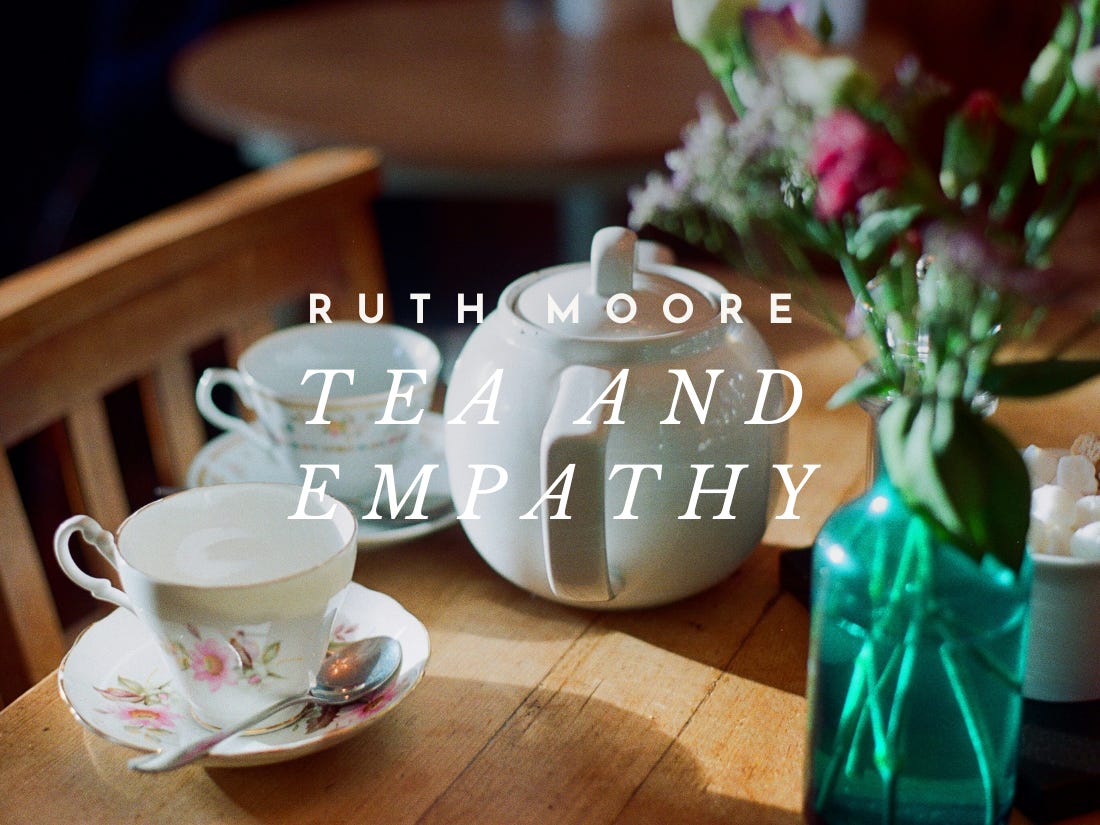
Lanier Ivester: The idea for Teamoot was born several years ago when Jennifer Trafton and I did a session on Lucy Maud Montgomery. We wanted to treat the participants to a taste of her world, so we made recipes based on the food in her books. And people loved it. There's just something about putting a real teacup in people's hands. It highlights how special and cared for they are as individuals. A couple years after that I hosted a mini Teamoot in the midst of the larger Hutchmoot, a space for people to come together over the civility surrounding the ceremony of tea. It really does lead to a sense of slowing down in the midst of all the excitement of the conference.
I feel like Teamoot really came into its own in 2024. We had a designated space and that made all the difference; I was able to really plan and prepare. Everyone had a place to sit, we had discussion questions, people engaged in conversations they wouldn't necessarily have begun. To me, that was the highlight of Hutchmoot—to see people making real connections over the tea table and loving the simple elegance of a proper cup of tea in a proper pot and a proper cup.
RM: Wonderful. Simply by answering that you've opened up a sense of the beautiful materiality of Hutchmoot. You make me wish I’d Teamooted, even though I’m that rare British woman who does not enjoy English breakfast tea!
Another visual cue of my trip was the sight of your Airstream parked outside North Wind Manor. It looked like a lovely place to return after full days of music and art and ideas. Do you enjoy traveling in it? How does life on the road interact with your own writing and thinking?
LI: We absolutely love traveling to Hutchmoot in our Airstream—or anywhere! It’s a 1962 24-foot model and we've had it for about 20 years. And the beauty of it is that wherever we wake up, it feels like home. But it's just so fun to wake up in Nashville, open the curtains and see North Wind Manor! We've called the Airstream our escape capsule because it has given us freedom to leave behind some of the complexities and cares of life for short times.
In terms of time on the road, my husband, Philip, and I have found that we actually get more work done when we're Airstream living because so many of the distractions are not there. It has given us a lot of space for creativity and deep work, and that's been a surprise benefit. In September of 2023, we planned a trip to Jekyll Island, which is our favorite place. Each morning before dawn we would take our two Australian Shepherd puppies to the beach and get them really tired. Then we came back and got to work. I actually finished my Glad and Golden Hours manuscript in the campground under the awning of the Airstream. It was 1,000° outside and I had a fan blowing on me and, you know, I'm at the beach! But I was able to make that space to mentally and imaginatively go to Christmas and finish my book.
RM: That sounds glorious—and a year later, you were at Hutchmoot hosting a seminar about that book! It also happened to be the 15th Hutchmoot. You have been there since the beginning. I remember you telling me by the fireside one night that things have changed a great deal. Tell us a story from an earlier edition. What has been lost and gained along the way?
LI: The first story that comes to mind is from my first Hutchmoot. I think we were the first people to sign up! We were excited to get to meet these people, who had inspired us so much, in real life.
But what I most remember was on the way up to Nashville I broke out in hives because I was so nervous about meeting my heroes and heroines. These people had really nourished me creatively and spiritually, and had played a huge role in my life. I was scared. I remember I walked in, and I told Pete how much his music had meant to me because I thought he was Andrew! Pete didn't let me off the hook; he said, “I don’t sing!” Immediately my nerves were just calmed. The fellowship and community I felt in that room. And I remember Andrew standing up and saying, “Hey, we don't know exactly what we're doing here, but we're really glad that you came to help us figure it out.” Such sincerity, such humility. I thought, I do belong here. I don’t have to impress anybody or prove anything. It felt like home.
Now it still has that spirit because it's the same people. It's the same core values, honed and sharpened and clarified. There has been a sense of something that's been lost just due to size—at the first Hutchmoot theoretically you could meet everybody, and now you would be exhausted! But I don't want to discredit the intimacy of the new Hutchmoot because you see so many pockets of community springing up. It's really special to see people walk in and just find their place.
RM: At Hutchmoot—at our UK edition too—we know we have precious people who love art but find it hard to make their way into like-minded community. And there are those who would find an event like Hutchmoot overwhelming however much they delight in art and story and music. What would you say to someone who longs for things like these but feels like a perpetual outsider?
LI: Well, the first thing I would say is, don't assume that you're the only person who feels that way. In a sense, I think we all feel like outsiders. That sense is why Andrew started the Rabbit Room in the first place. And it has been a beautiful way of helping people find their people.
It can be overwhelming, a large conference like Hutchmoot. It's sometimes billed as a conference for introverts. Much provision is made for introverts, but I would urge people not to use this as an excuse to withdraw. Start conversations; ask questions. Look for someone who seems as lost as you might feel and find out what brought them there. When Diana Glyer gave her keynote address a number of years ago, she had just written her book Bandersnatch on the creative community between the Inklings and, specifically, Lewis and Tolkien. She urged the audience not to just look at their friendship and long for it, or pine for it, or even covet it. She encouraged everyone to go home and find somebody that they could just connect with. To not wait until they had the perfect circumstances. But to just start. To call up a like-minded friend and say, “Hey, can we meet for coffee? Can we FaceTime once a week?” Whatever it looks like. And so many artistic friendships and communities and projects have come out of that one piece of advice.
RM: You write wonderfully about the sacramental nature of everyday living. Before we close, can you offer us a glimpse of something that is glimmering in the everyday for you this week?
LI: Oh, yes—absolutely! I’ve started all of my seeds out in the potting shed, and every time I check their progress it just renews my hope in the promise of the resurrection. It never fails to astonish me that so much life and beauty can come from such tiny, dead-looking things. Those little seedlings tell me that life is always the trajectory in God’s economy.
Ruth Moore is a writer from Oxford, England, and a member of the Hutchmoot UK team.
Lanier Ivester hails from the beautiful state of Georgia, where she maintains a small farm with her husband, Philip. She is the author of Glad & Golden Hours: A Companion for Advent and Christmastide, and her special areas of interest include the heaven-imaging essence of home and the sacramental nature of everyday life.
For more resources on art and faith, sign up for our other newsletters: Poetry, Music, and Articles.
To support the work of the Rabbit Room, join us by becoming a member. Your membership helps fund everything from publishing new books to new podcasts, events, poetry, articles, theatre productions, conferences, and more. Membership is vital to our flourishing, and we’d love for you to participate. Click here to join or learn more.